Factories and Production Floors

Plants · Lines · Multi-Site Groups

Video for Factories and Production Floors

Manufacturing plants, assembly lines, plant-plus-warehouse sites, clean or high-noise halls, and multi-site groups all require vigilant floor supervision. The floor staff must simultaneously monitor entry points, enforce line discipline, and ensure occupational safety. Night shifts are often understaffed. Restricted machines, unauthorized departures from posts, and skipping standard operating procedures (SOPs) can easily go unnoticed during routine walk-arounds. Cameras and AI systems are typically installed separately for production lines, warehouse aisles, and office entrances. Most existing HD cameras can be evaluated initially, so there is no need to replace the entire plant’s surveillance system at once.

Three Things the Floor Actually Needs

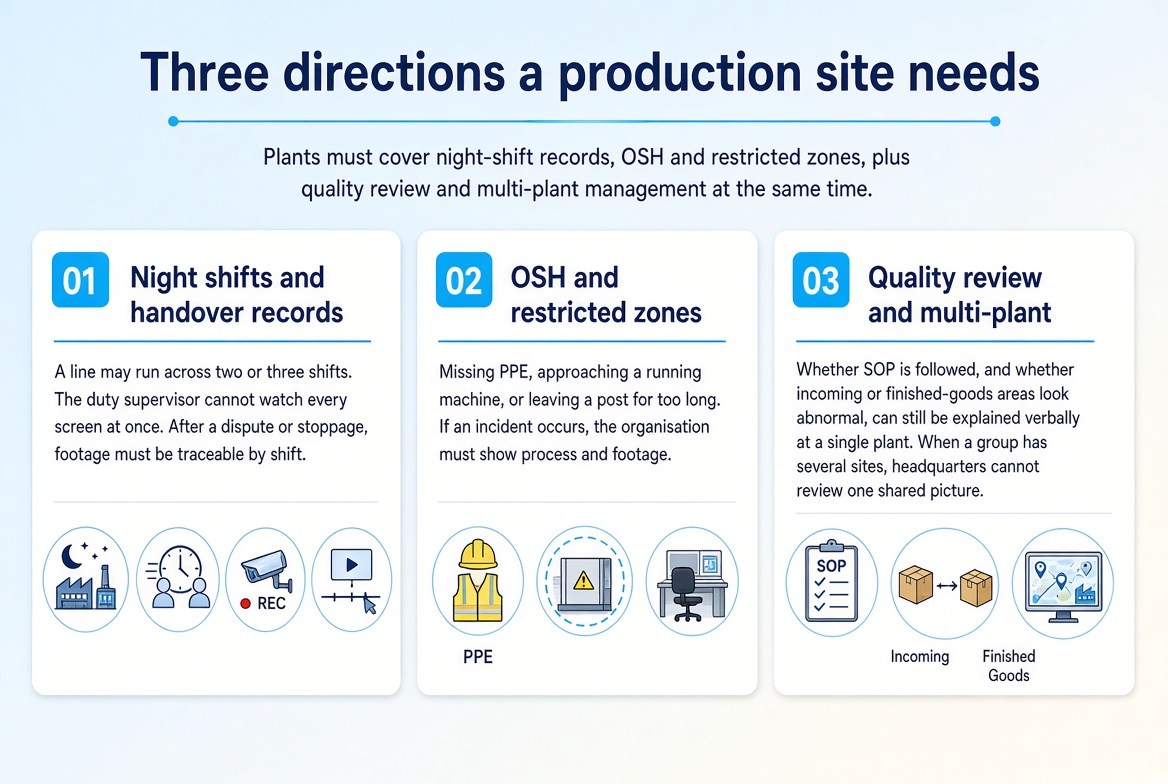
A plant must still address the night-shift record, safety and no-go zones, as well as quality review and multi-site oversight.
EkgBz

Night Shift and HandoverA single production line can run two or three shifts. The supervisor on duty cannot view them all in one picture. After a dispute or a stoppage, you need an audit trail.

Safety and No-Go ZonesNo PPE, standing too close to a live machine, leaving a post unattended for too long. After an accident, the company must provide a documented process and video evidence.

Quality Review and Multi-Site OversightWhether the SOP was followed, or whether incoming or finished goods look wrong—one plant can still talk it through internally. With several plants, head office cannot review everything in one view.

Functions You Can Enable Line by Line

Main gate, clock-in area, both sides of the line, machine no-go zones, finished goods aisles, and electrical rooms.
All-Day Plant Recording and Maintenance

3W4CH
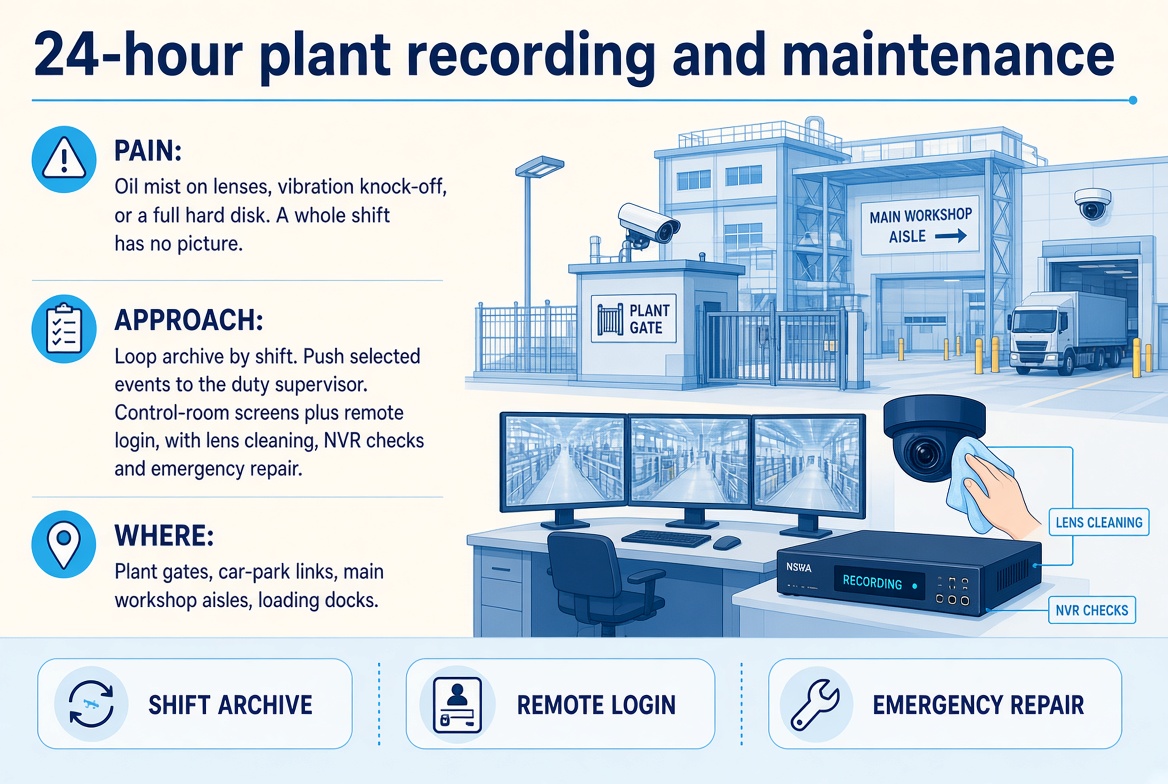
Pain: Oil mist on the lens, vibrations knocking it off aim, or the disk filling up can result in an entire shift without any picture.
How: Archive by shift. Push named events to the supervisor on duty. Control-room screens plus remote login, backed by lens cleaning, NVR checks, and emergency repairs.
Where: Plant gate, car park link, main shop floor aisles, and loading dock.

Face Attendance

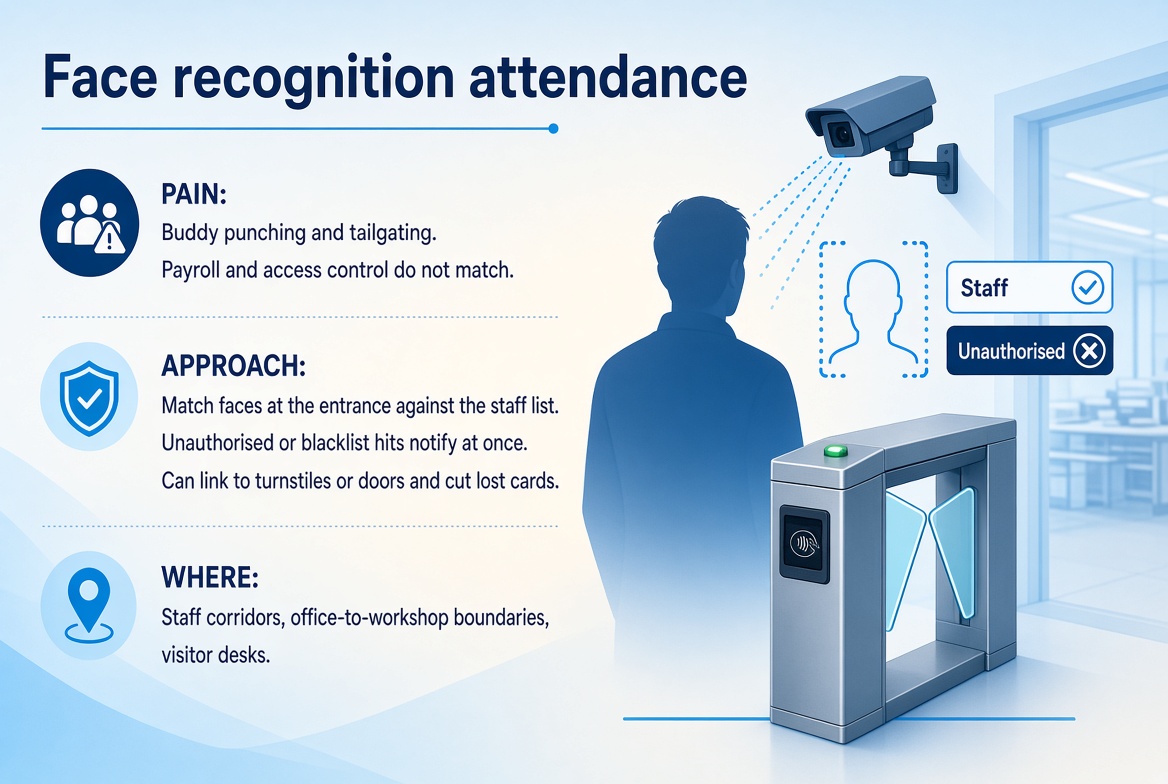
Pain: Buddy punching and tailgating occur. The payroll records do not match the door access list.
How: Doors match faces to the staff list. Unknown individuals or those on the watch list trigger an alert. The system can be linked to turnstiles or access control, reducing the number of lost cards.
Where: Staff passages, the office–shop boundary, and the visitor desk.

Leaving a Post

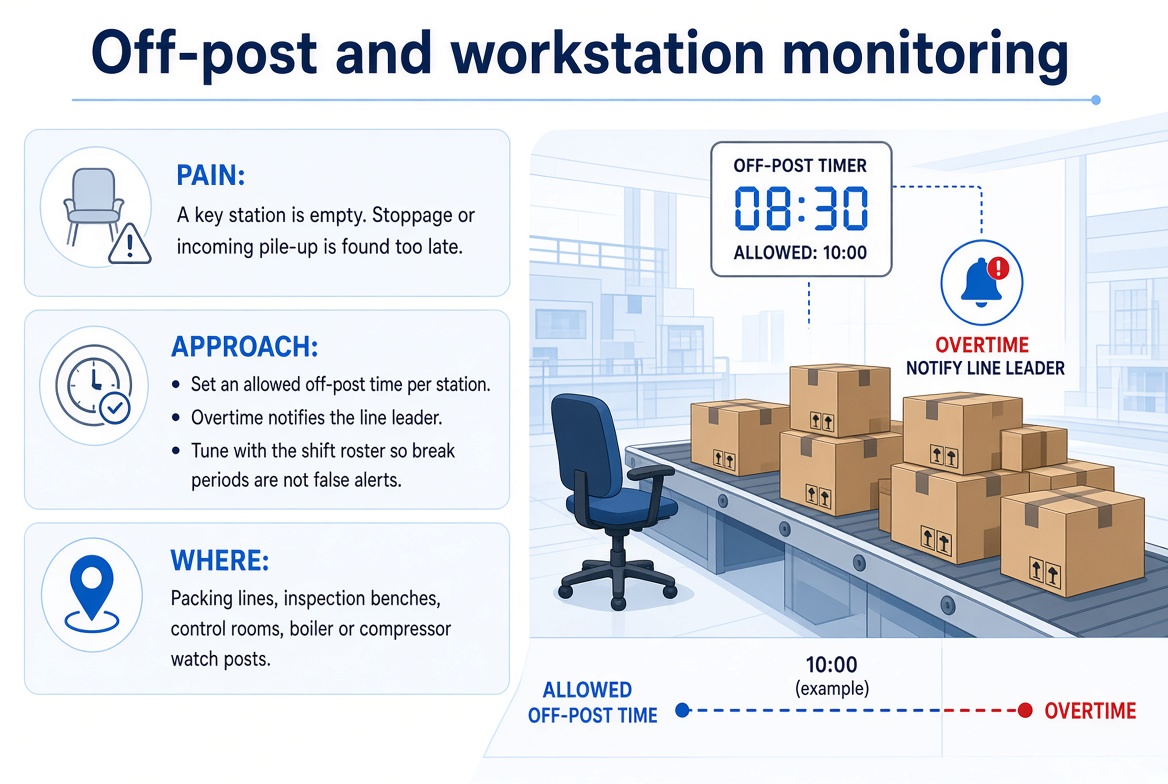
Pain: A key station sits empty, but you only notice after a stop or a surge of incoming work.
How: Set the maximum duration a station may remain unoccupied. If this time is exceeded, the line leader is notified. This setting is adjusted according to the shift roster to prevent rest breaks from triggering excessive alerts.
Where: Packing lines, inspection benches, control rooms, and boiler or compressor watch posts.

Crowds and Clashes

CBlCQ
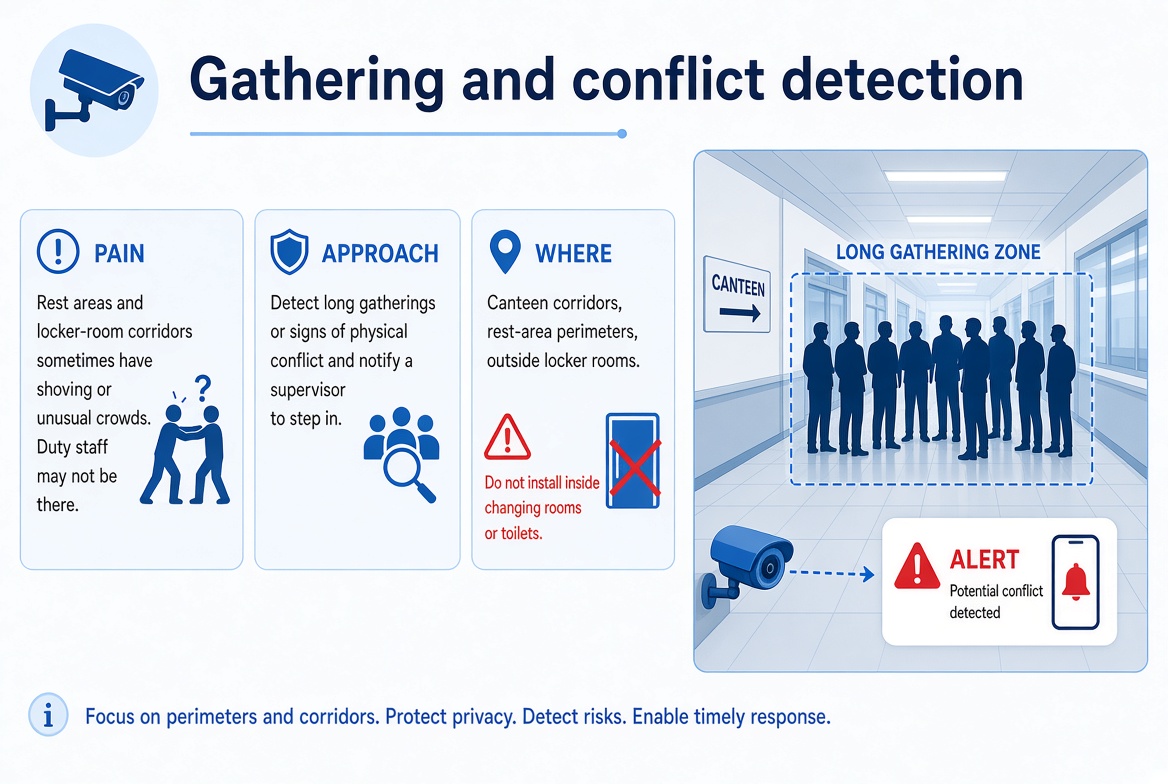
Pain: A shove or an unusual crowd outside the rest area or changing-room passage. The person on duty is not always present.
How: Flags a prolonged gathering or fight so a supervisor can intervene.
Where: Canteen passages, around rest areas, and outside changing rooms. Do not install cameras inside changing rooms or toilets.

Restricted Work Zones

20BFX
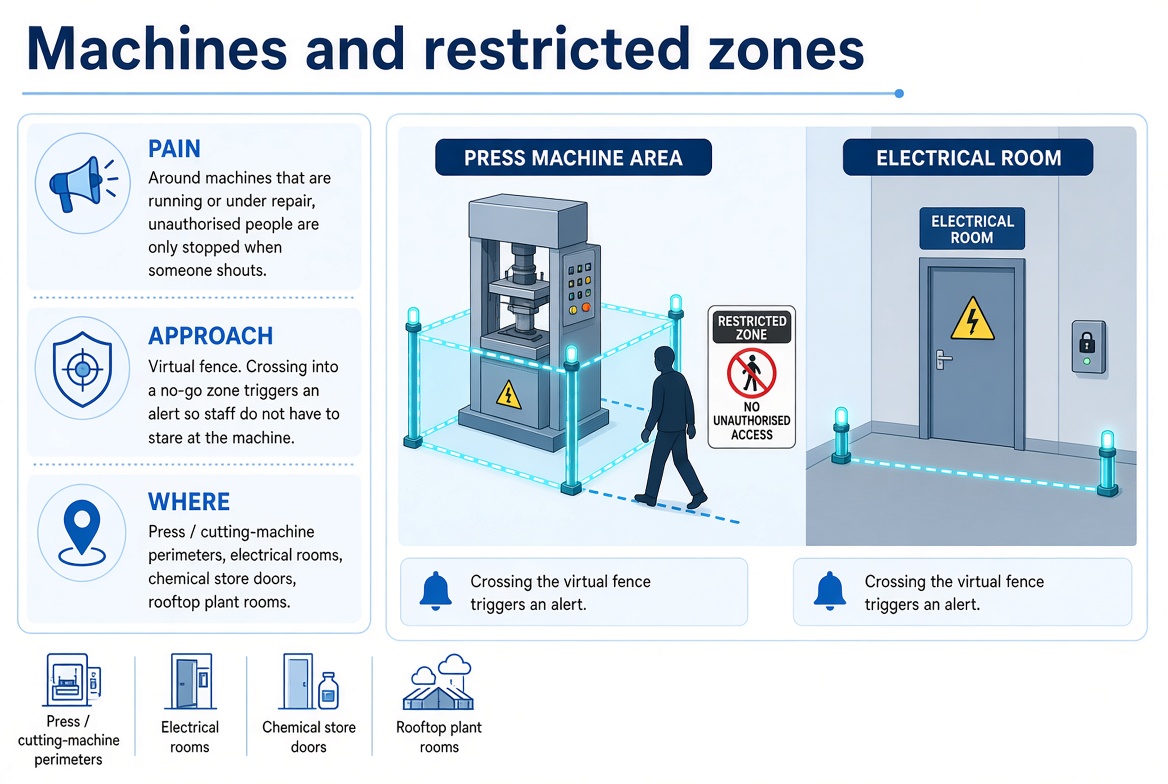
Pain: Around a machine that is under repair or still running, an unauthorized person is only stopped when they are already too close.
How: A virtual fence is used. Entry into the no-go zone triggers an alarm, so no one has to constantly monitor the machine.
Where: Areas around press and cutting stations, electrical rooms, chemical storage doors, and rooftop plant rooms.

SOP Rules for the Process

FRUFf
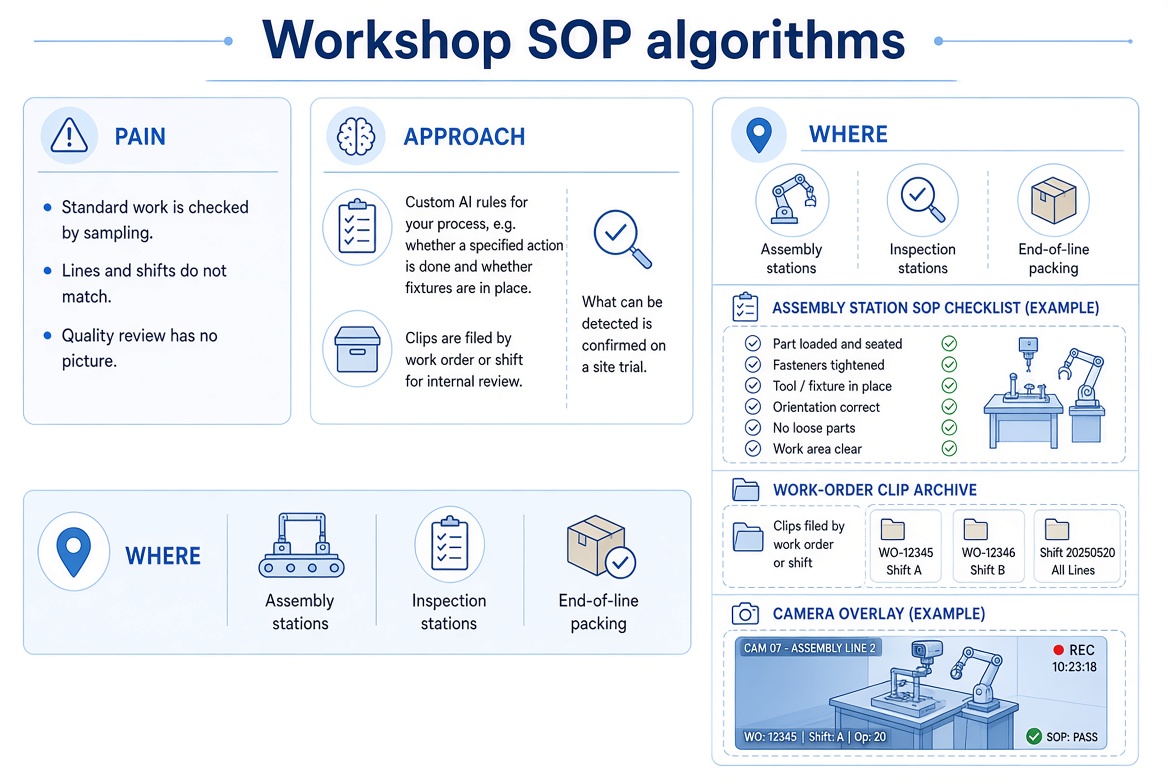
Pain: Standard work is verified by sampling. However, there is inconsistency between lines and shifts, and quality review lacks video records.
How: AI rules are written for your process—such as whether a named action is performed or not, and whether PPE is in place. Clips are filed by work order or shift for internal review. What can actually be detected is determined during a site trial.
Where: Assembly stations, inspection stations, and the end of packing.

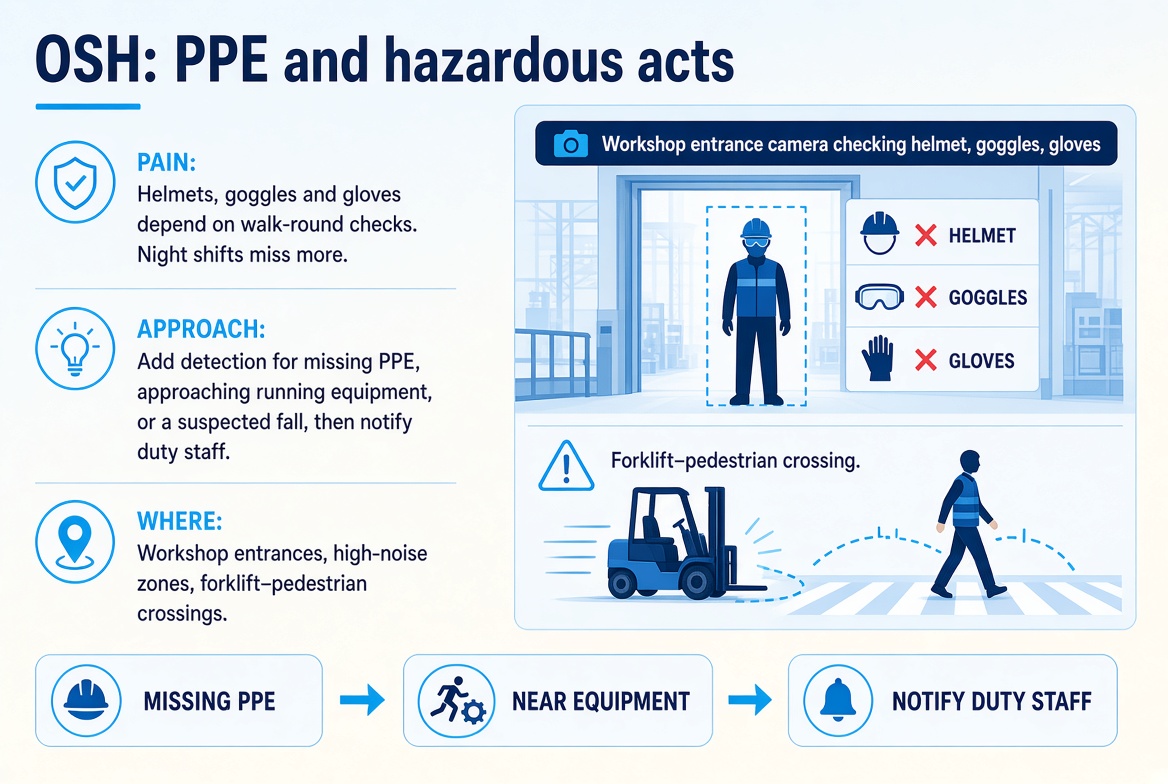
PPE and Hazardous Movements

AET6d
Pain: Helmets, goggles, and gloves rely on walk-round checks. Night shifts tend to miss more of these.
How: Can flag missing PPE, standing too close to live equipment, or a suspected fall, and notify the person on duty.
Where: Shop floor doors, high-noise zones, and areas where forklifts and pedestrians cross.

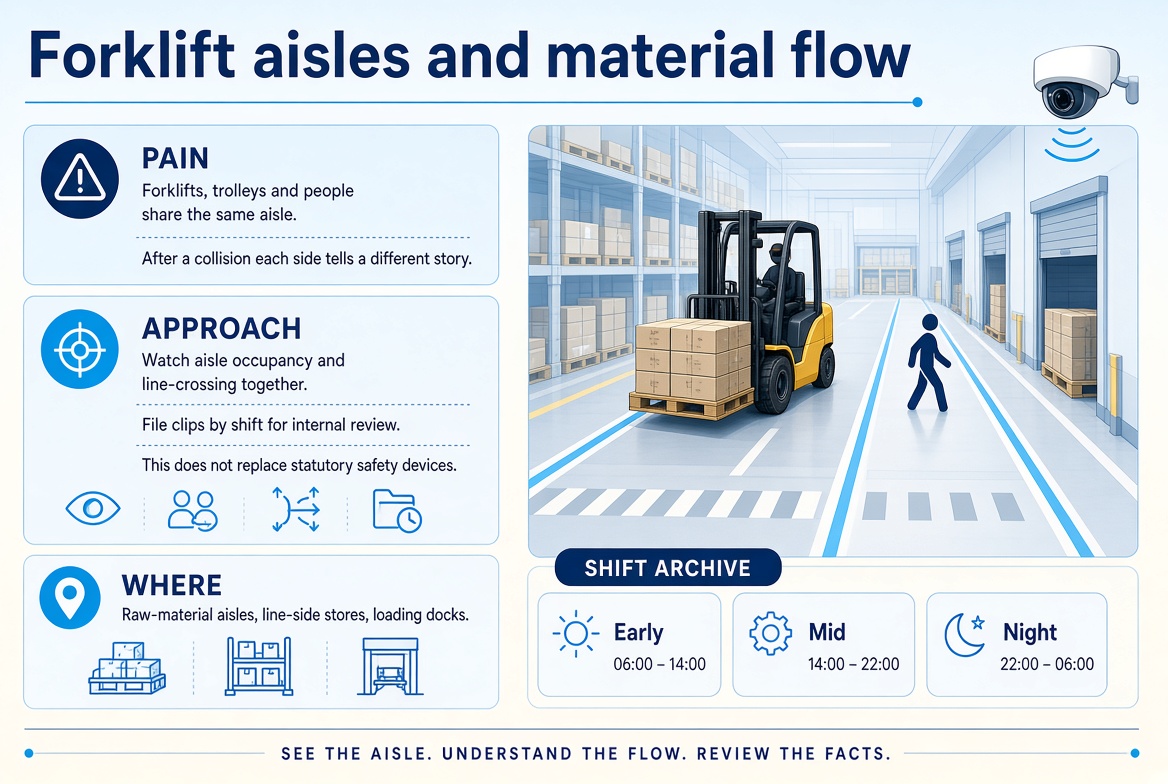
Forklift Aisles and Material Flow

fbvT9
Pain: Forklifts, trolleys, and pedestrians share a single aisle. After a collision, each party tells a different version of the incident.
How: Watch aisle occupancy and overstepping simultaneously. Clips are filed by shift for internal review. This procedure does not replace statutory safety devices.
Where: Raw-store aisles, line-side stores, and loading docks.

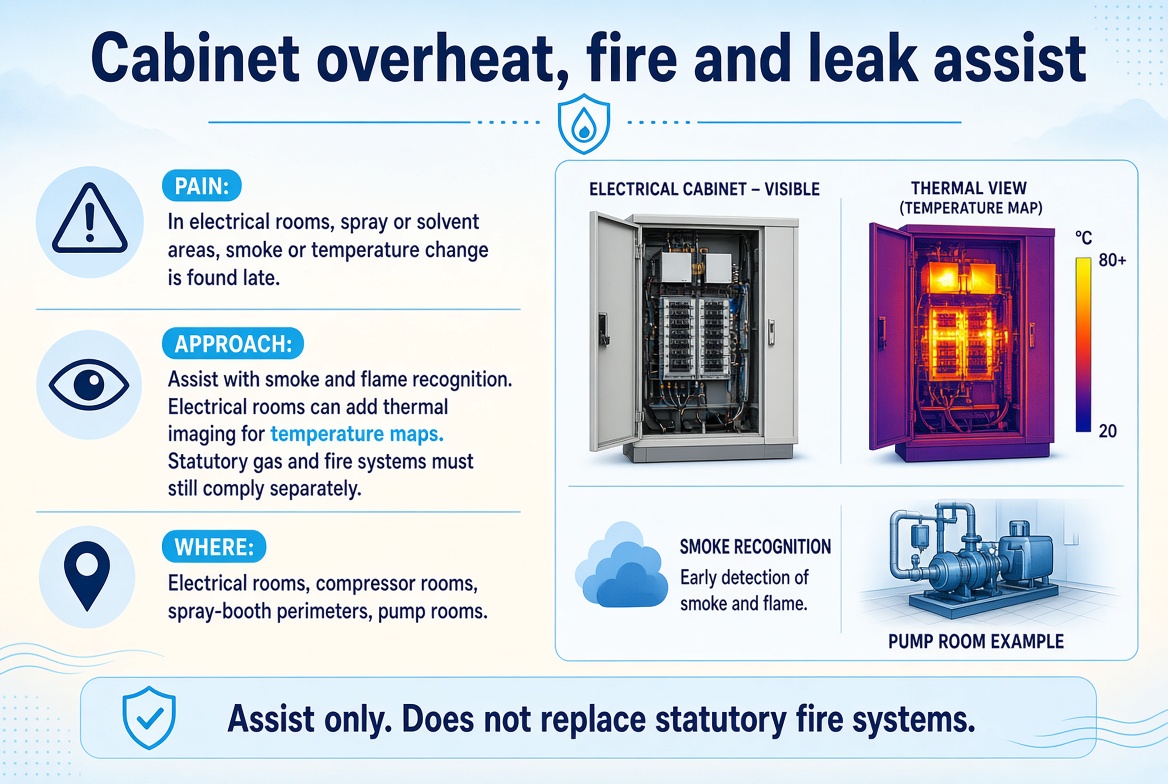
Hot Boards, Fire, and Leak Support

3HPiv
Pain: In electrical rooms and spray or solvent areas, smoke or a temperature spike is often detected too late.
How: Video support for smoke and flame detection. Electrical rooms can use thermal imaging to display heat. Statutory gas and fire equipment must still comply independently with the plant code.
Where: Electrical rooms, compressor rooms, areas surrounding spray booths, and pump rooms.

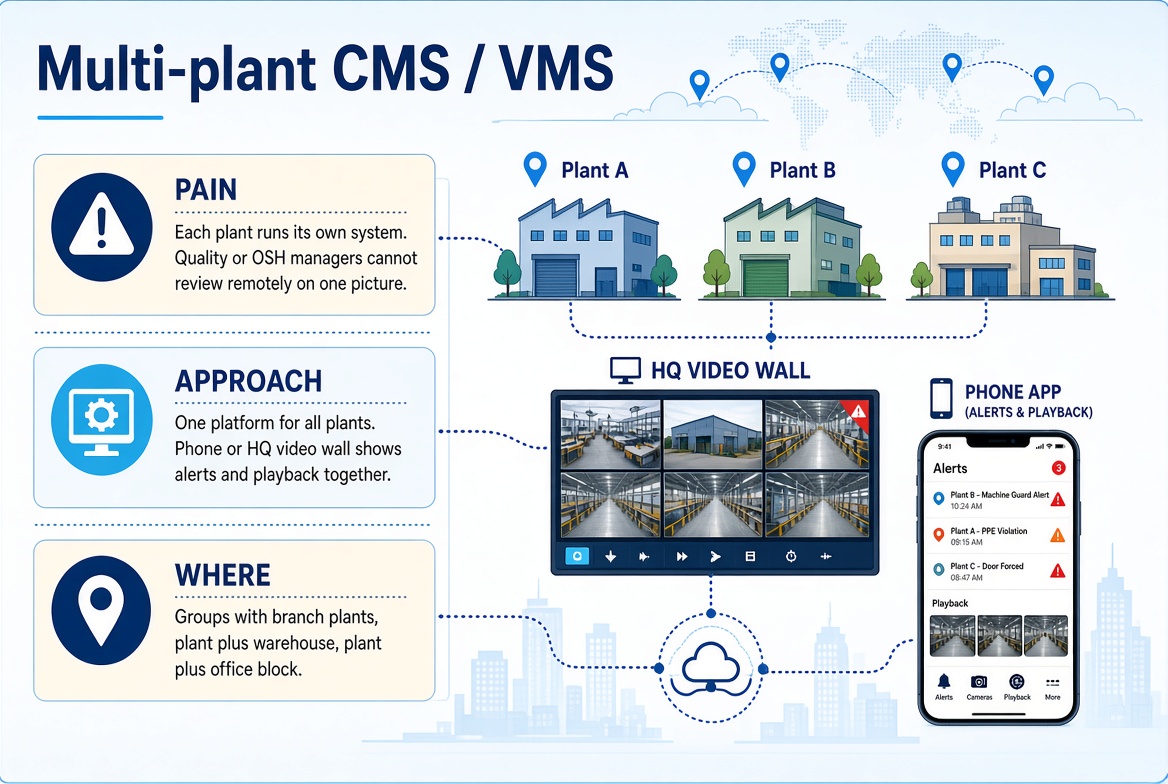
Multi-Plant CMS/VMS

PjC3c
Pain: Each plant operates its own system, making it impossible to review quality or safety from a single location.
How: One platform for every plant: a phone or a head-office wall display shows alarms and playback.
Where: Groups consisting of more than one plant, a plant combined with a warehouse, or a plant combined with offices.

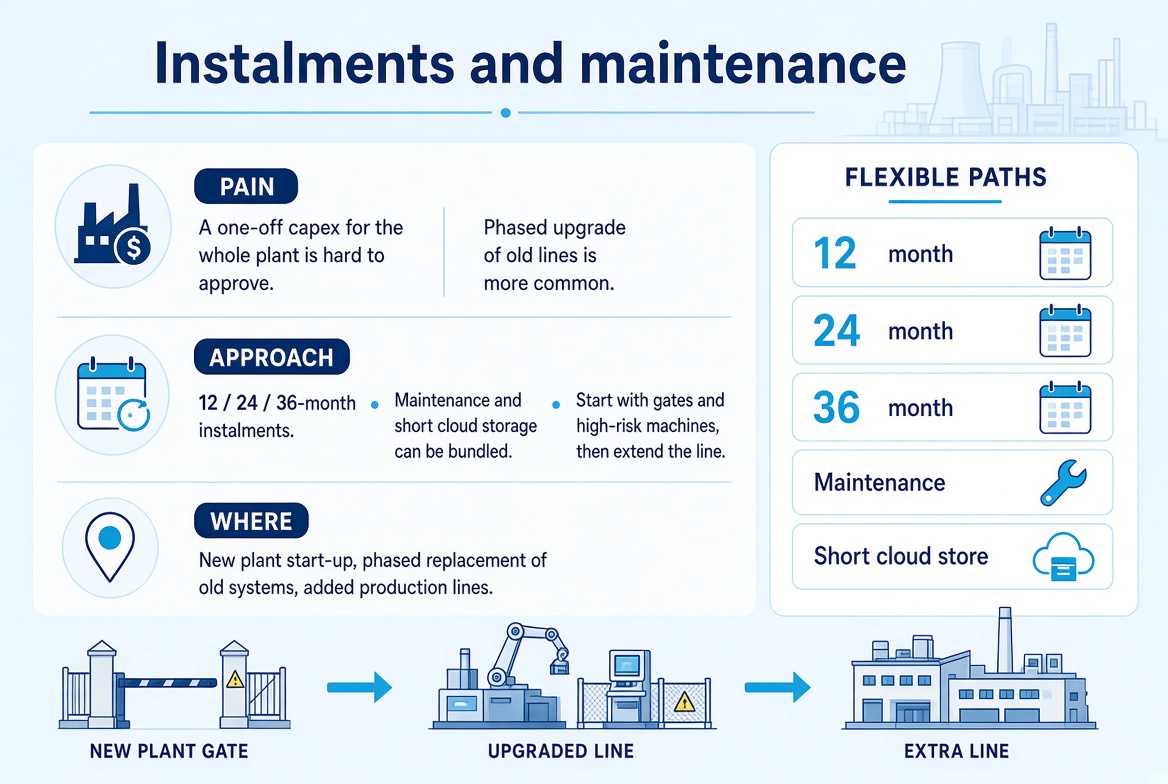
Installments and Maintenance

Pain: Securing a one-time capital investment for the entire plant is challenging. Older production lines are more commonly rebuilt in phases.
How: 12-, 24-, or 36-month installments. Maintenance and a short cloud loop can be combined into a single payment. Prioritize coverage for the main gate and high-risk machines, then expand the coverage gradually.
Where: A new plant opening, old systems replaced in stages, and additional production lines.

Plants We Can Name

Sites where our systems are already installed, or that we may list publicly. Contract terms and plant rules apply.

Site Photo

Food production plant

1

Automated production floor

1

Different zones of a factory campus

1

Questions Plants Ask

If the floor uses facial recognition, how is staff privacy protected?

Use cameras on doors and shared passageways only. Do not install cameras in changing rooms, showers, or inside restrooms. We advise on audio or silent recording by zone and assist the plant in drafting the internal notice.

Do SOP rules work right out of the box?

No. The rules are established after a trial involving your process, camera angles, and lighting. The quote specifies the scope of the trial separately.

Must every old camera be replaced?

Not usually. We first check whether the resolution and angle are sufficient for AI. The main gate and machine no-go zones are prioritized; the line can be added in stages.

Will “leaving a post” detection also flag a legitimate break?

We adjust acceptable times based on the station and shift roster, and we can also include a manual verification.

Does thermal imaging replace electrical inspection?

No, it only displays heat as a supporting image. Periodic electrical inspections still adhere to plant regulations.

Can multiple plants be managed through a single app?

Yes, we can consider a CMS/VMS system with separate access rights for the head office and the plant.

Enquire About Factories and Production Floors

For line SOP, leaving a post, face attendance, or machine no-go zones, we can walk the floor. Please tell us the plant type, the camera brands already installed, and which station you want us to handle first.

Call 3107 2778

📞 3107 2778
🌐 icam.hk
WhatsApp chat