Elderly homes · day centres · community venues
CCTV for social-welfare sites
Fewer wander-offs. Faster response. More time for care.
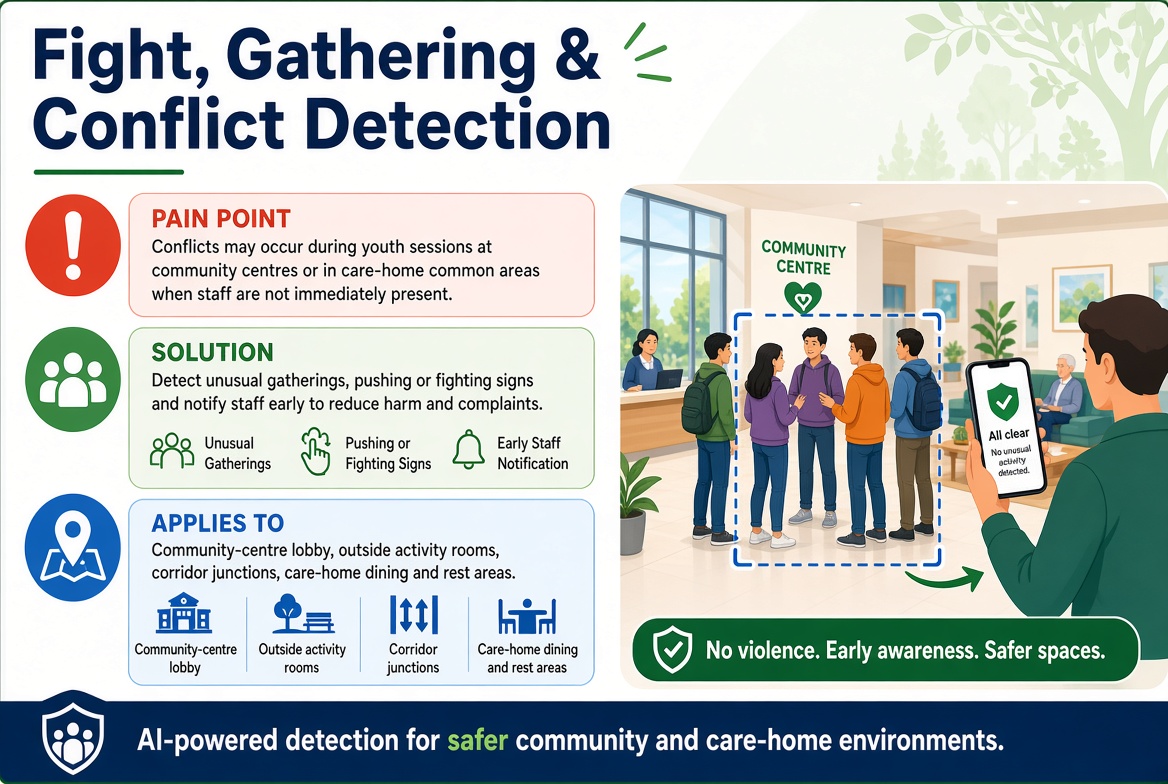
Built for residential care homes, day centres and community activity venues: 24-hour watch on corridors, stairs and back doors, plus fall detection, unusual-crowd alerts, and face-based anti-wandering for residents living with dementia. Management sees every site from a phone or one central platform.
CCTV for social-welfare premises
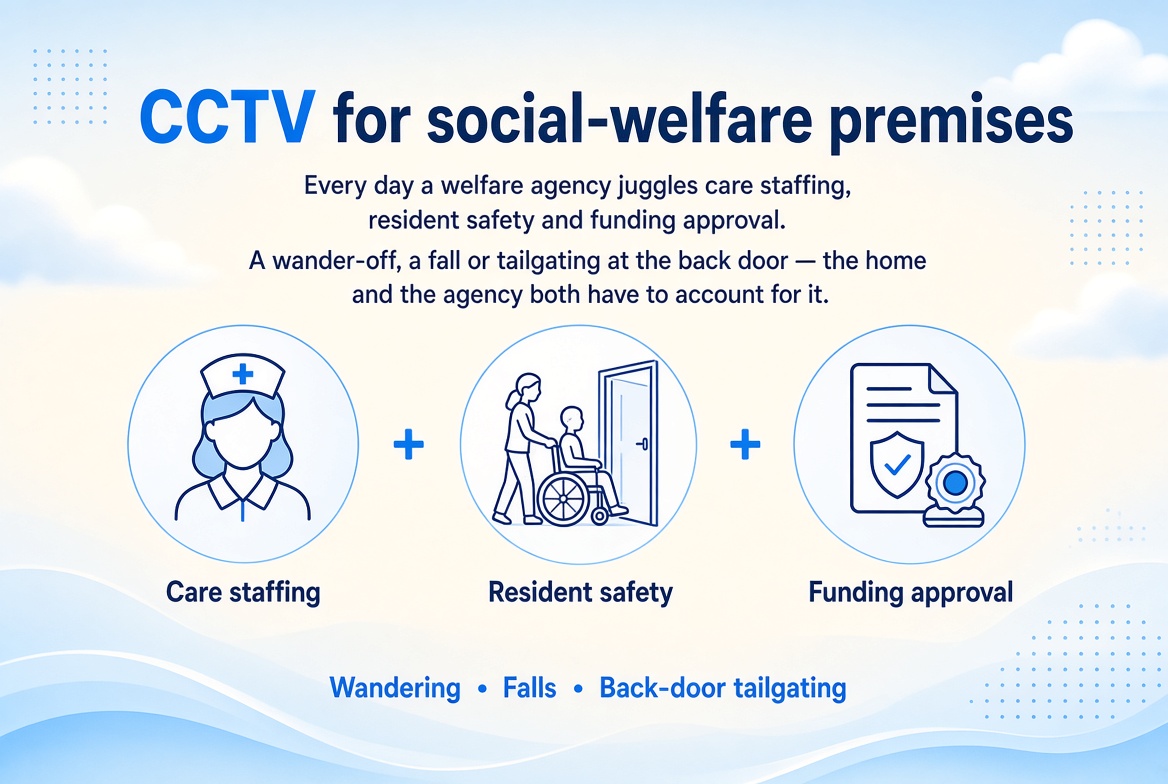
Every day a welfare agency juggles care staffing, resident safety and funding approval. A wander-off, a fall or tailgating at the back door — once it happens, the home and the agency both have to account for it.
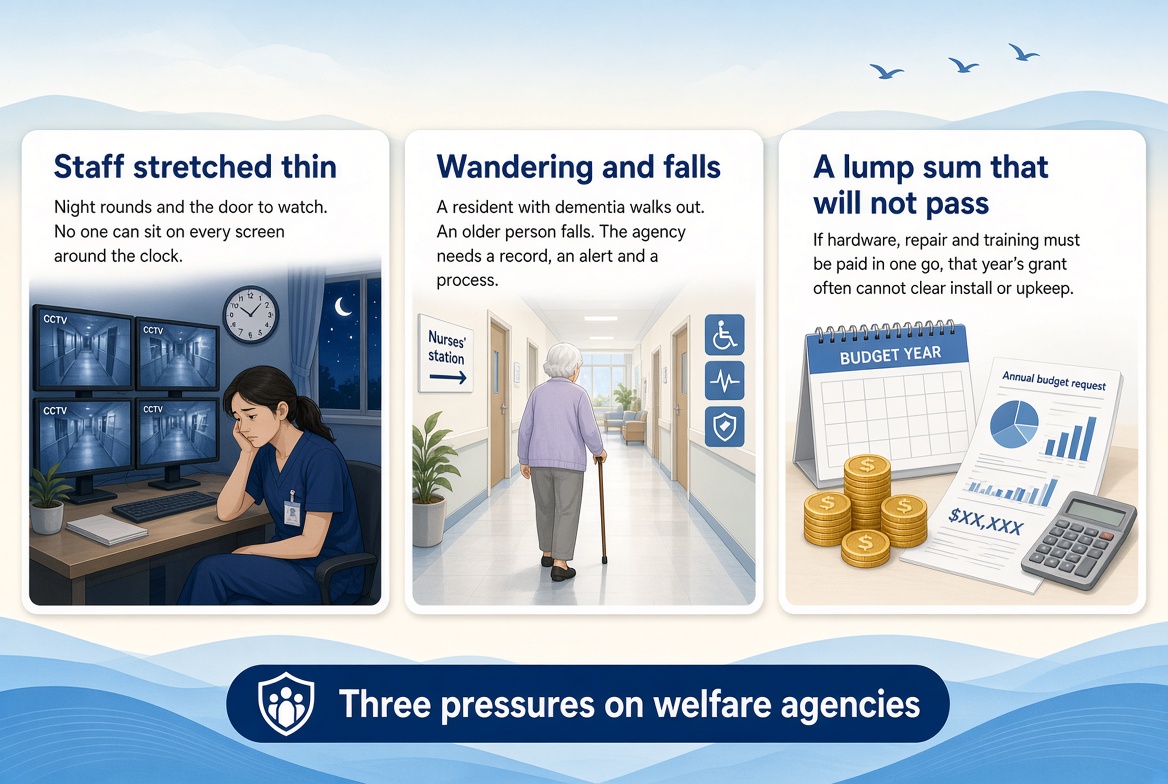
Staff stretched thin
Three night rounds and a door to watch. No one can sit on every screen around the clock.
Wandering and falls
A resident with dementia walks out. An older person falls. The agency needs a record, an alert and a process.
A lump-sum budget that will not pass
If hardware, repair and training have to be paid in one go, that year’s subvention often cannot clear it.
One security stack
The risk points common to elderly homes, community centres, day centres and rehab units.
24-hour venue security
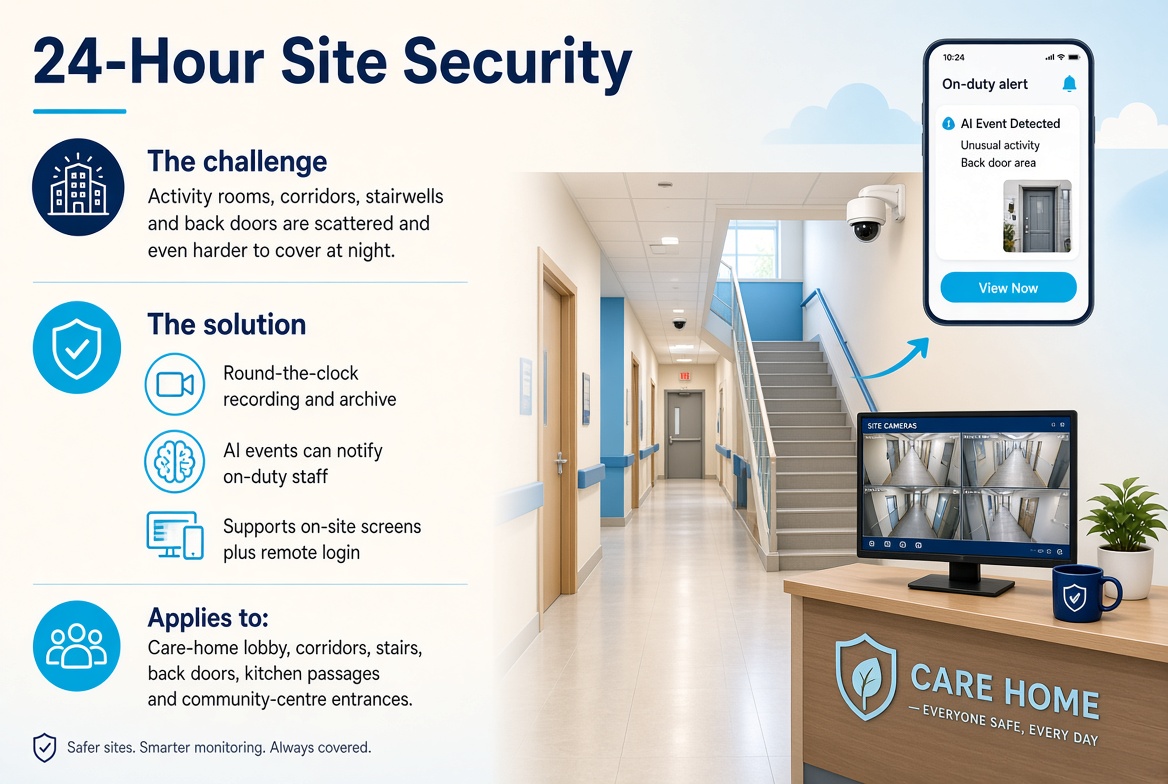
Pain: Activity rooms, corridors, stairs and the back door sit far apart. Night makes it worse.
Solution: Round-the-clock recording. Optional AI alerts to whoever is on duty. On-site monitors plus remote login.
Apply: Home lobby, corridors, stairs, back door, kitchen passage, community-centre doors.
🩺 Falls and unusual behaviour
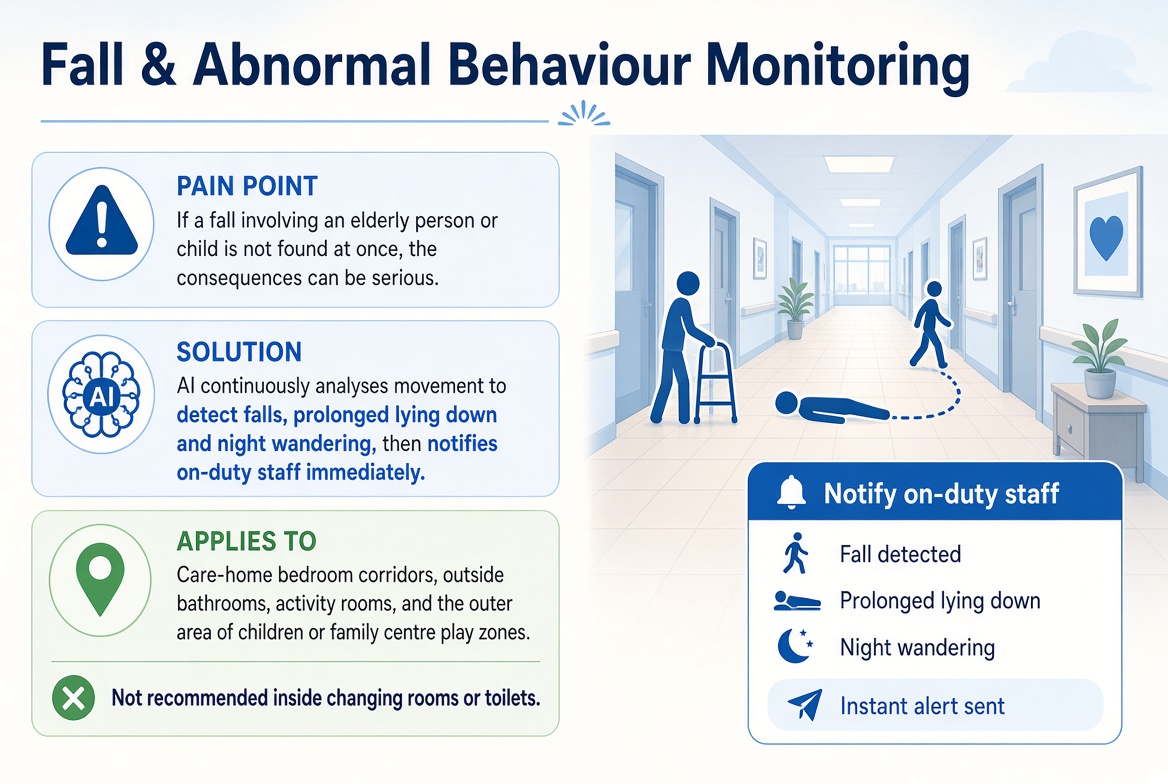
Pain: If an older person or a young child falls and no one sees it at once, the outcome can be serious.
Solution: AI watches movement for a fall, a long time on the ground, or night-time wandering, and tells whoever is on duty.
Apply: Bedroom corridors in elderly homes, outside bathrooms, activity rooms, the edge of play areas in child / family centres. Do not put cameras in changing rooms or toilets.
Central platform (VMS / CMS)
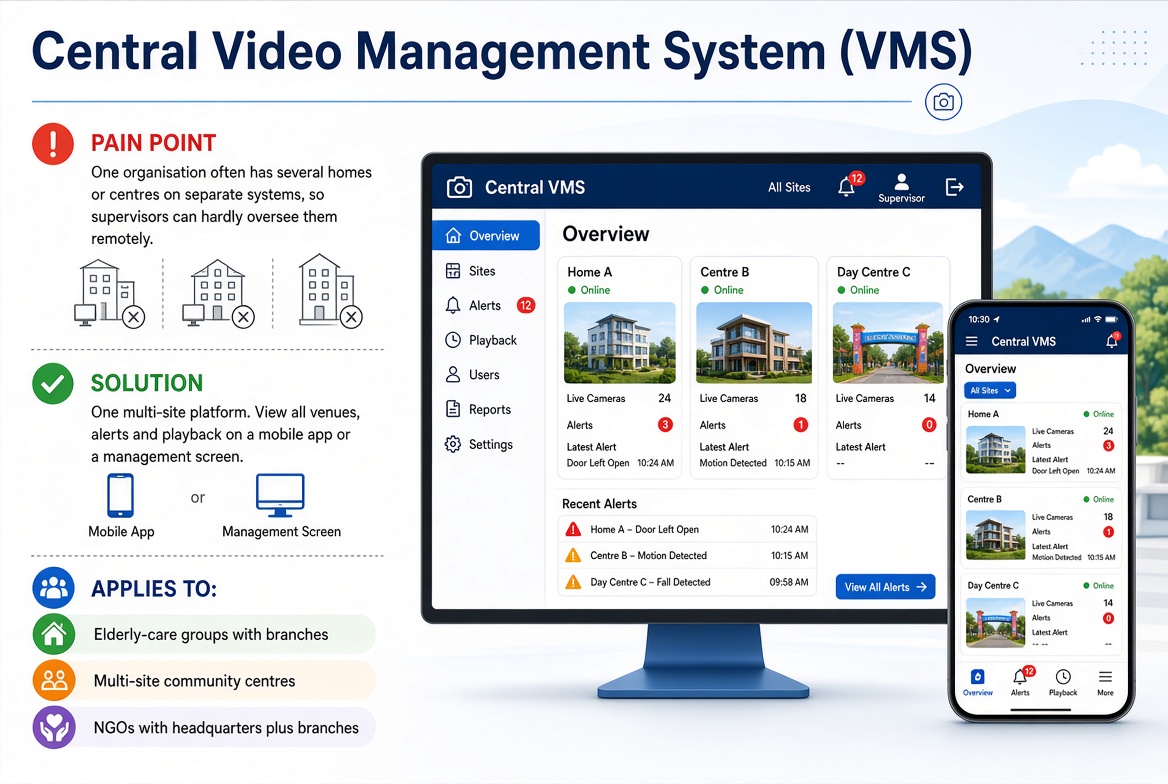
Pain: One agency often runs several homes or centres, each on its own system. The duty officer cannot see them from one place.
Solution: One platform for every site. Phone app or office wall shows all venues, alarms and playback.
Apply: Elderly agencies with more than one home, multi-site community centres, a headquarters plus branches.
Face-based anti-wandering
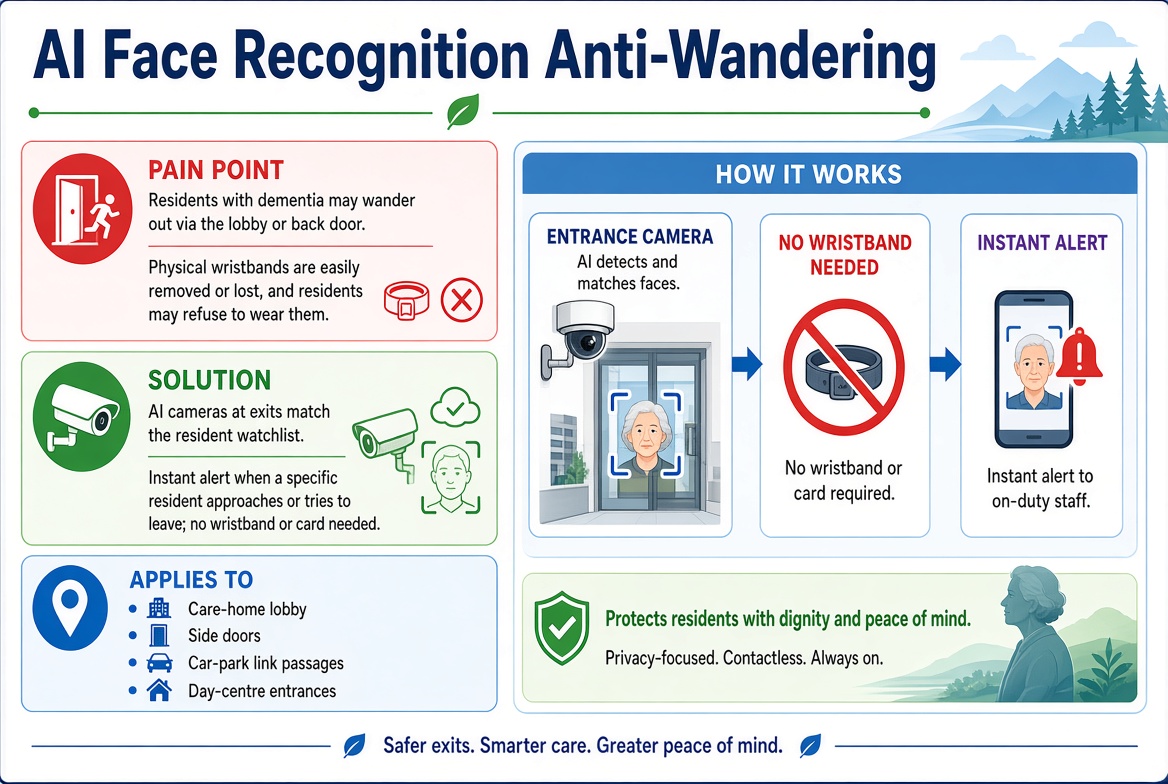
Pain: Residents with dementia slip out through the lobby or back door. Wristbands come off, get lost, and some residents will not wear them.
Solution: Door cameras match faces to the resident list. If a named person comes close or tries to leave, staff are warned at once. No band, no card.
Apply: Home lobby, side doors, car-park link, day-centre doors.
Access by role: resident / family / staff / visitor
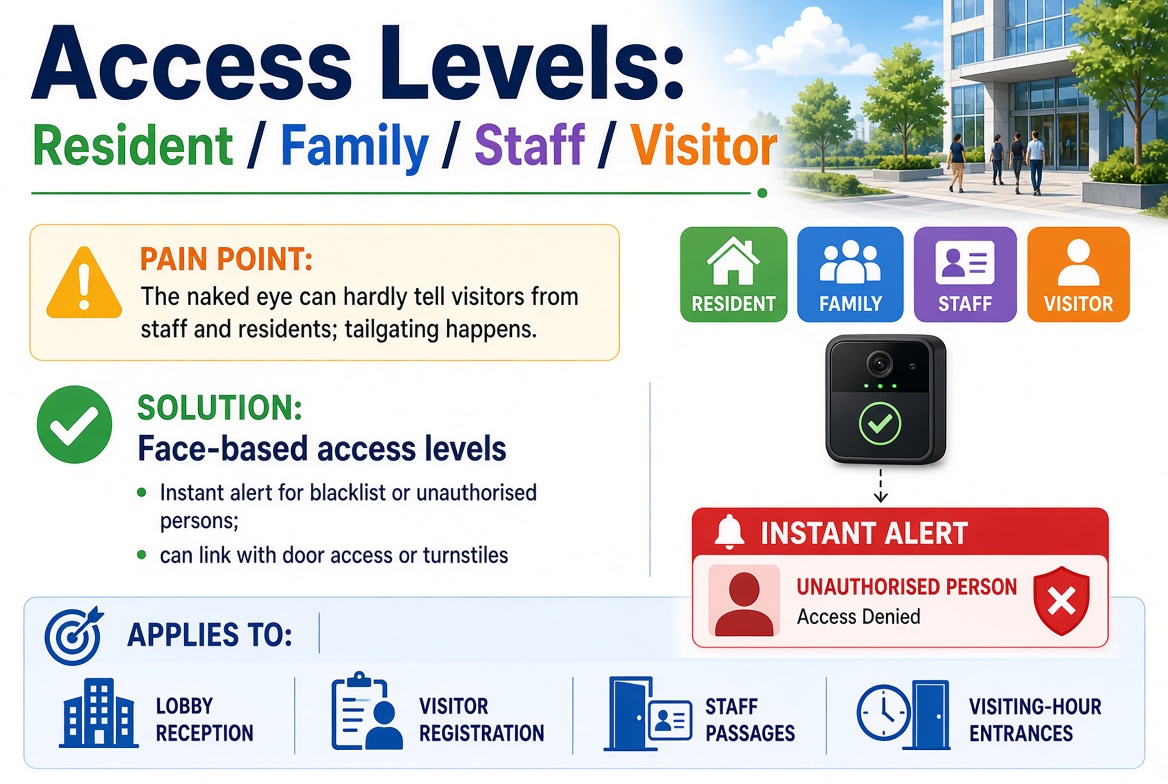
Pain: The eye alone cannot tell visitor from staff from resident. Tailgating happens.
Solution: Face access by role. A watch-list or unknown person raises an alarm. Can link to doors or turnstiles.
Apply: Lobby reception, visitor desk, staff passages, doors during visiting hours.
🚧 Perimeter and restricted rooms
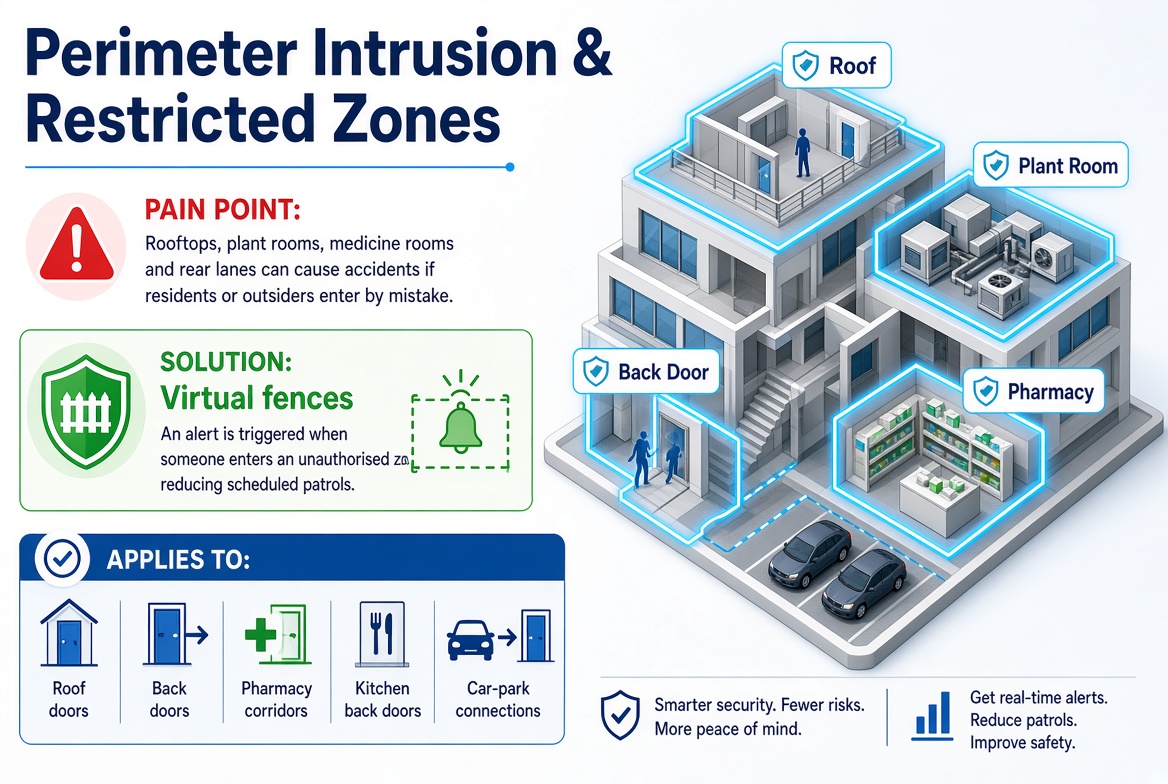
Pain: Roof, plant room, medicine room, rear lane — a resident or a stranger walking in can end in an accident.
Solution: A virtual fence. Entry to a no-go zone raises an alarm, so floor patrols need not be clockwork.
Apply: Roof doors, back door, pharmacy corridor, kitchen back door, car-park link.
Instalments and the I&T Fund (OPEX)
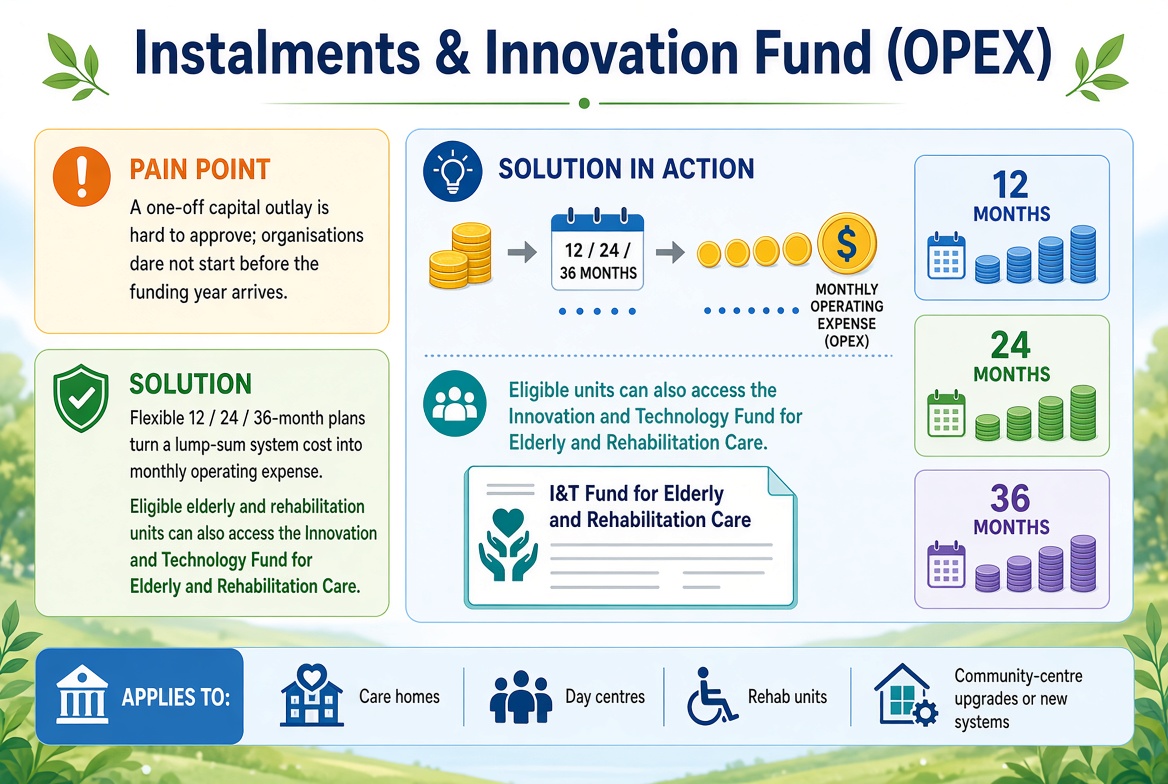
Pain: A one-off capital vote is hard to get. Teams will not start before that year’s grant lands.
Solution: 12 / 24 / 36-month plans turn a lump-sum system cost into a monthly operating cost. Eligible elderly and rehab units can also look at the Innovation and Technology Fund for Application in Elderly and Rehabilitation Care.
Apply: Elderly homes, day centres, rehab units, community-centre refits or a new system.
No wristband. Nothing to wear.
Anti-wandering built for residents living with dementia
Face-recognition anti-wandering
Door cameras match faces to the home’s list. When a named resident comes close or tries to leave, the nurse station and whoever is on duty are told — so staff can step in before the person reaches the street.
- No kit on the person: no band or card to refuse or lose
- By role: resident, family, staff and visitor sit on different rights
- Edges covered: back door, side door and roof door as well
- A file: the alert clip is kept for internal review and family talks
Why welfare agencies work with us
We know how a home runs
Visiting hours, the night shift, the medicine room and the back door — not just cameras.
Wandering and falls leave a record
Alert clips are kept, for families, the board and the regulator.
Most existing cameras can stay
Old CCTV can often take AI. You do not strip the building in one go.
Privacy by room type
Bedrooms, bathrooms and changing rooms: no camera, or silent / no-face only. Faces belong on corridors and doors.
Instalments plus I&T Fund advice
Start the safety piece that cannot wait, then spread cost across the funding year.
Someone stays after handover
Train nurses and the officer, remote help, scheduled maintenance and emergency repair.
Agencies we can name
Some homes, day centres and community bodies that have used this work
Organisation |
Photo |
|---|---|
Pok Oi Hospital Chan Fung Man Ling Care and Attention Home |
|
Po Leung Kuk Headquarters, 66 Leighton Road |
|
Caritas House, Caine Road |
|
Yang Memorial Methodist Social Service — Lei Yue Mun Chun Long Integrated Rehabilitation Service Centre |
|


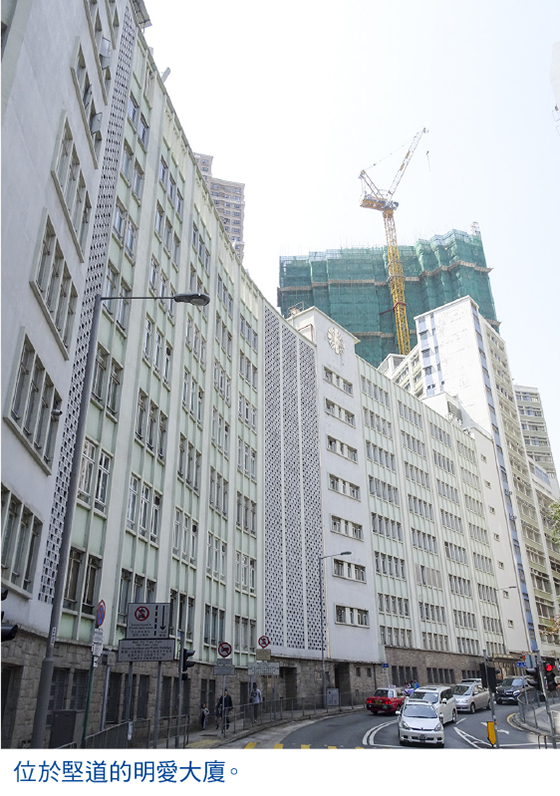

At the client’s request, some homes are named only — indoor photos are not published.
How the work runs
Free venue survey
Layout of the home or centre, doors, and wander-off risk
Design the mix
By zone: face, fall, fence — or recording only
Install around the day
Avoid meals, afternoon rest and peak visiting
Train and go live
Nurse station, officer’s phone app, a run-through of the alert flow
Stay on the job
Maintenance, list updates, fine-tuning the model
Questions homes and centres ask
If an elderly home uses face recognition, how is privacy handled?
Faces belong on doors and public corridors — not in bedrooms, bathrooms or changing rooms. We advise audio or silent, face or no-face, by room, and help the agency write the internal note.
Will fall detection keep false-alarming?
We tune it to corridor width, lighting and how residents move, and can add a human check to cut false alerts.
Do we have to replace every old camera?
Not usually. Many existing HD cameras can join AI and VMS. Cover the doors and the back door first, then grow the system.
Our community centre is only open in the day. Do we still need this?
You can record only during opening hours, plus alerts on the back door and stairs. Functions can follow a timetable.
Can we apply to the I&T Fund for Elderly and Rehabilitation Care?
Eligible subvented elderly and rehab units can be assessed. We can supply the technical spec and the venue plan for the application file. Approval follows Social Welfare Department rules.
Can we start with anti-wandering and add the rest later?
Yes. Build in modules: doors first, then falls, crowds or a full-site VMS.
Talk to the social-welfare team
For anti-wandering in an elderly home, fall detection, community-centre security or an instalment plan, we can walk the ground at no charge. The aftercare and the install follow the real layout of the home or centre.


